Blog
Content
Artificial Intelligence (AI) in hospitality: building the infrastructure for an agentic future
It’s not enough for AI to simply recommend a hotel — it needs to book it, pay for it, and reconcile the transaction instantly and securely.

Imre Vogelezang
Co-founder & CPO
Artificial Intelligence is reshaping travel. However, in hospitality, it’s not enough for AI to simply recommend a hotel — it needs to book it, pay for it, and reconcile the transaction instantly and securely.
That’s only possible with the proper infrastructure. And at Katanox, we’re building it.
What is agentic AI in hospitality?
Most travelers today have already encountered AI — from personalized recommendations to dynamic pricing engines. Research from Milestone predicts that by the end of 2026, half of all search traffic will flow through AI engines, ushering in a significant change in hotel discovery.
But Agentic AI is different. It represents a shift from passive assistance to active execution.
In hospitality, Agentic AI doesn’t just suggest a property or compare rates; it completes the transaction. It can search for availability, confirm a reservation, process payment, and handle post-booking processes like invoicing and reconciliation — all autonomously and within seconds.
Imagine a traveler asking their AI assistant to “book a boutique hotel in Amsterdam for next weekend.”
Instead of redirecting them to a booking site, the AI agent independently presents the best option(s), confirms with the traveler what to book, secures the room, pays the hotel, and syncs the transaction with both the traveler’s and the hotel’s financial systems.
No forms. No redirects. No manual intervention.
But this level of autonomy requires deep connectivity. For AI to act on behalf of a traveler or a hotel, it must interface directly with reservation, payments, and financial systems — and it must trust that the data it’s accessing is accurate, structured, and up to date. Without that foundation, even the most advanced AI agent can’t perform reliably.
That’s why Agentic AI in hospitality isn't just about intelligence—it’s about infrastructure. It’s about creating a predictable, harmonized layer between hotels, distributors, and payment networks that allows AI to move beyond conversation into commerce.
From buzzwords to backbone
McKinsey’s latest insights on Agentic AI in travel reveal where the industry is headed — toward autonomous, end-to-end systems that not only respond but also act. AI agents that can search, price, book, and settle transactions in real-time.
But in travel, that’s a more complex problem to solve. The industry is highly fragmented, with “cobbled together systems” and siloed data spread across countless independent hotels, suppliers, and intermediaries. Without harmonized data and financial infrastructure, AI can’t perform reliably — and worse, it can hallucinate.
Because of these limitations, early iterations of Agentic AI-powered travel booking only provide recommendations and require the user to finalize the booking manually. However, this output is simply a metasearch in a different skin.
That’s where Katanox comes in.
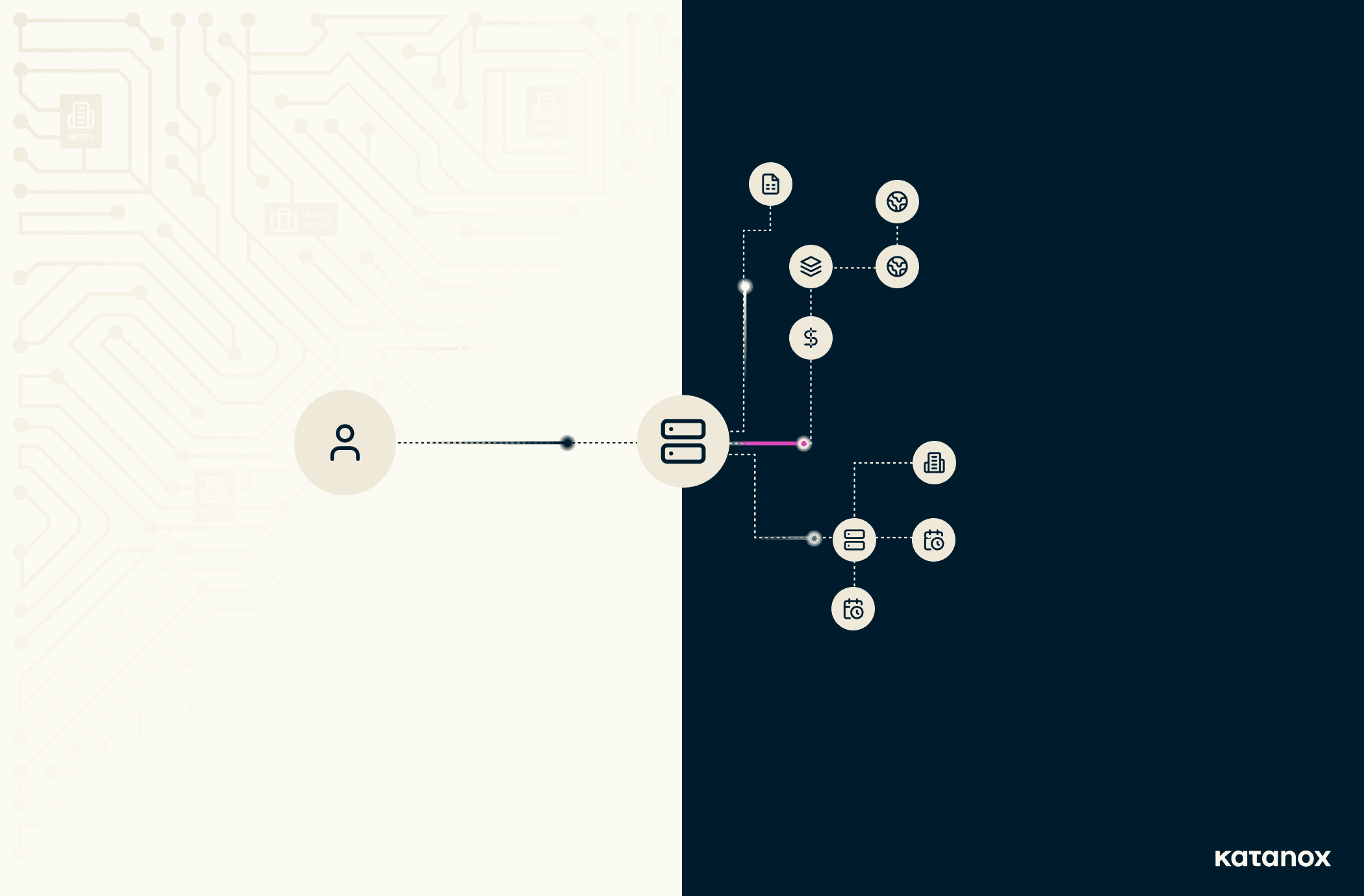
We’re building the predictable, harmonized interface that AI needs to interact with hospitality systems. Through our APIs, we integrate directly with core reservation and financial systems, creating the native financial and distribution backbone that enables agentic travel commerce.
The infrastructure for agentic AI
To make AI functional — not theoretical — in hospitality, the underlying technology must support a tightly connected stack of financial, operational, and data systems. AI doesn’t work in isolation — it relies on trustworthy, verifiable, and real-time data, as well as the ability to transact seamlessly across fragmented networks.
Here’s what that looks like in practice:
1. Real-time fraud detection, reconciliation, and risk scoring
AI can only operate autonomously when every transaction is verifiable and transparent. That requires real-time fraud detection and instant risk scoring that identifies anomalies before they become losses.
In traditional travel distribution, fraud checks, chargeback management, and reconciliation happen in silos — often manually and days after a transaction. In an AI-driven environment, that’s unacceptable. Agentic systems must verify, score, and reconcile transactions in milliseconds.
Katanox’s financial infrastructure is designed for precisely this. We enable real-time verification and matching of transactions across systems, providing instant reconciliation between reservations and payments.
This not only reduces operational friction but also gives AI agents the confidence to execute transactions autonomously — without the human-in-the-loop bottlenecks that currently slow down the industry.
2. Automated processing of millions of content requests and payouts
The volume of data in hospitality is staggering. Every minute, distribution and financial systems handle thousands of price updates, availability checks, image refreshes, and content verifications.
Now multiply that by AI-driven agents that continuously query and transact at scale — and you have millions of content requests and payouts per day.
Manual or semi-automated systems can’t handle this. They weren’t built for real-time, automated distribution.
That’s why Katanox built an automation-first architecture capable of processing high-frequency requests with low latency.
Our platform facilitates the continuous exchange of information between inventory, content, and payments, enabling AI to operate seamlessly without requiring human or batch updates.
Automation is the backbone of agentic commerce. It’s what enables a hotel to be discoverable, bookable, and payable through any AI interface, 24/7, without latency or downtime.
3. A native financial and distribution backbone that lets AI agents transact autonomously
AI in travel can’t just recommend — it must transact. That means not just passing along booking information, but actually executing and settling payments in real time.
As Platform Aeronaut observed, “The magic trick of an agentic future is discovery → selection → payment → servicing in one continuous conversation.”
To make that magic possible, AI agents need direct access to native financial infrastructure — not third-party off-ramps or redirect links. Otherwise, the process is nothing more than a glorified metasearch.
At Katanox, we built this backbone natively. Our infrastructure enables AI agents to book, pay, and reconcile transactions within a single, connected environment.
By embedding payments directly into the distribution process, we eliminate the latency and data fragmentation that plague legacy systems.
This architecture turns every AI agent into a true commercial actor — one capable of transacting on behalf of users safely, instantly, and at scale.
4. A predictable interface that eliminates system inconsistencies and prevents AI hallucinations
One of AI’s most significant weaknesses is uncertainty. When faced with inconsistent, incomplete, or conflicting data, AI systems can hallucinate — fabricating details, prices, or availability.
In travel, this isn’t just inconvenient; it’s destructive. It breaks trust.
To prevent this, AI requires a predictable and harmonized interface — one where data formats, system behavior, and response times are consistent.
Katanox was built to be that interface. We harmonize fragmented systems into a single, structured API layer that normalizes data flow between hotels, travel agents, and financial systems.
This gives AI agents a clean, reliable surface to work from — no guesswork, no inconsistencies.
Predictability is what transforms AI from a “smart assistant” into a trusted transactional partner.
5. Deep integrations with reservation and financial systems for precise, real-time decision-making
In hospitality, operational decisions occur quickly: a room gets booked, a payment fails, a cancellation arrives, or pricing shifts in response to demand.
For AI to operate effectively, it must be plugged into the deep core systems that drive these decisions — both reservation systems (central reservation systems (CRS)/ property management systems (PMS) and financial systems (payments, reconciliation, ledgers).
Katanox integrates at this depth. By connecting directly into the foundational layers of hospitality technology, we provide the real-time visibility AI agents need to make accurate, high-stakes decisions autonomously.
It’s this level of integration that transforms AI from a reactive tool into a proactive operator — one that can adjust rates, process payments, and update content dynamically as the environment changes.
6. Automated margin and pricing management through applied AI
Pricing in the hospitality industry is complex, often managed through manual spreadsheets, siloed systems, or opaque algorithms used by online travel agents (OTAs).
But in an agentic world, static pricing is obsolete.
AI can analyze thousands of market signals in real-time — including competitor rates, occupancy levels, booking windows, and demand surges — and instantly adjust pricing to optimize margins.
Katanox is developing automated margin and pricing solutions that enable this. By connecting revenue management directly to AI systems and live transaction data, hotels gain an intelligent, self-adjusting pricing layer that reacts to real market conditions.
The result: dynamic profitability, managed automatically and continuously.
The road ahead
The shift to agentic AI is transforming travel planning and booking from manual processes to autonomous experiences. However, this transformation will only succeed if the infrastructure underlying it is strong, secure, and well-coordinated.
At Katanox, we’re not chasing buzzwords. We’re building the foundation — the financial and distribution layer that allows AI to book, pay, and reconcile in real time, safely and transparently.
As agentic AI matures, it will move from assisting to acting. From recommending to reconciling. From theory to transaction.
And when it does, the hospitality ecosystem that thrives will be the one built on structured data, integrated systems, and intelligent infrastructure — exactly what Katanox is delivering.
Artificial Intelligence is reshaping travel. However, in hospitality, it’s not enough for AI to simply recommend a hotel — it needs to book it, pay for it, and reconcile the transaction instantly and securely.
That’s only possible with the proper infrastructure. And at Katanox, we’re building it.
Imre Vogelezang
Co-founder & CPO
Share